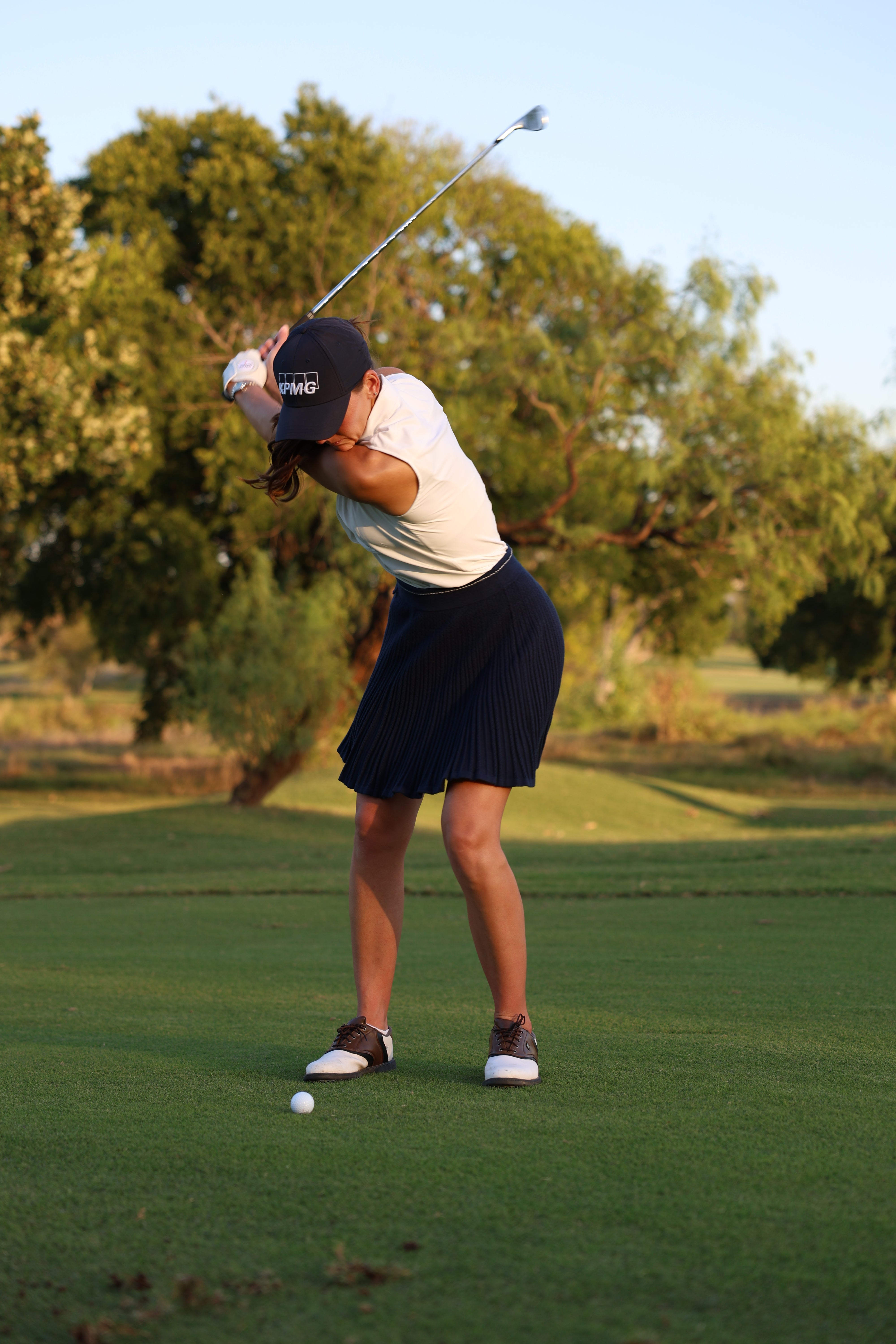

Understanding golf terminology can be a game-changer, especially for those who are new to the sport or beginning to participate in corporate networking events. This glossary is designed to be an easily accessible reference, breaking down the essential terms and phrases that will help you feel more confident both on the course and in golf-related conversations. Whether you're navigating your first corporate golf outing or simply picking up the game for fun, knowing the lingo can make a huge difference in your comfort level and enjoyment.

General
- Par – The standard number of strokes for a hole, relevant throughout the course.
- Eagle – Scoring two strokes under par on a hole.
- Birdie – Scoring one stroke under par on a hole.
- Bogey – Scoring one stroke over par on a hole.
- Double Bogey – Scoring two strokes over par on a hole.
- Handicap – A numerical measure of skill, used in scoring across the entire round.
- Fore – A universal warning shout to protect others from a misdirected ball.
- Lie – Refers to the ball’s position anywhere on the course.
- Penalty Stroke – Added to a player's score for violations or entering hazards, regardless of location.
- Clubface – The part of the club that strikes the ball, essential in every shot from tee to green.
- Mulligan – A do-over shot, typically informal, without penalty (*Not permitted in official competitions, but commonly allowed during corporate events or charity tournaments where mulligans are used for fundraising).
- Slice – A shot that curves sharply to the right (for right-handed players; opposite for left-handed players).
- Hook – A shot that curves sharply to the left (for right-handed players; opposite for left-handed players).
- Handicap – A numerical measure of a golfer's skill, allowing for fair competition.
- Hazard – Any area, such as water or sand, that makes play difficult.
-
Draw – A controlled shot that curves slightly left for a right-handed golfer (
opposite for left-handed players). -
Fade – A controlled shot that curves slightly right for a right-handed golfer (
opposite for left-handed players). - Fat Shot – A mishit where the club strikes the ground before the ball, losing distance (typically will include taking a large chunk out of the ground).
- Thin Shot – A mishit where the club barely contacts the ball, sending it low.
- Gimme – A short putt that opponents concede as made in casual play (not allowed in official competitions), typically because it's considered close or easy to make.
Around the Tee Box
- Tee Time – A pre-arranged time to start a round of golf, essentially like setting a golf "appointment."
- Tee Box – The designated starting point for each hole, where the ball must be placed between the two "Tee Markers" for the initial shot.
- Drive – A long-distance shot taken from the tee box.
- Fore – A warning shout when a ball is heading toward another person.
- Dogleg – A hole that bends to the left or right, rather than going straight.
In the Fairway
- Fairway – The closely mowed area between the tee and the green.
- Rough – The longer grass surrounding the fairway.
- Divot – A chunk of turf removed during a shot.
- Punch Shot – A low, controlled shot used to keep the ball under the wind.
- Pitch Shot – A high shot that travels a short distance, usually onto the green.
- Approach Shot – A shot intended to land the ball on the green.
Around the Greens
- Green – The area of closely mowed grass surrounding the hole, where putting occurs.
- Putt – Used on the putting green and typically e xecuted with a putter, which is specifically designed for this purpose, allowing for precision and control on short-distance shots.
- Chip – A short shot from just off the green to get the ball onto the green.
- Bunker – A sand-filled hazard on the course.
- Fried Egg – A lie in a bunker where the ball is half-buried in the sand.
- Up-and-Down – Getting the ball into the hole in two strokes from off the green, usually the "up" is with a chip and the "down" is referencing one putt into the hole.
- Lag Putt – A long putt designed to stop close to the hole rather than go in.
- Flop Shot – A high, soft shot played with an open clubface, often near the green.
- Pin – Another term for the flagstick on the green.